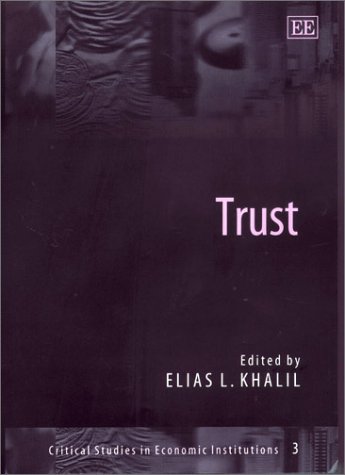
Trust / edited by Elias L. Khalil.
Material type: TextLanguage: English Publication details: Cheltenham : Elgar, 2003. Description: xxxii, 772 p. ; 25 cmISBN: 184064737xSubject(s): Trust | EconomicsDDC classification: 330.01 Online resources: WorldCat details
 | Item type | Current library | Collection | Call number | Copy number | Status | Date due | Barcode | Item holds |
|---|---|---|---|---|---|---|---|---|
 Text
Text
|
Dr. S. R. Lasker Library, EWU Reserve Section | Non-fiction | 330.01 TRU 2003 (Browse shelf(Opens below)) | C-1 | Not For Loan | 16911 |
Browsing Dr. S. R. Lasker Library, EWU shelves, Shelving location: Reserve Section Close shelf browser (Hides shelf browser)

|

|

|

|

|

|
|
||
| 330 CAE Economic issues today : | 330 KRE 2018 Economics / | 330.01 TIE 2017 Economics for the common good / | 330.01 TRU 2003 Trust / | 330.015 KIS 2017 Structural vector autoregressive analysis / | 330.0151 CHF 1984 Fundamental methods of mathematical economics / | 330.0151 CHF 1984 Fundamental methods of mathematical economics / |
Introduction: why does trustworthiness pay? three answers, Elias L. Khalil. Part 1 Trust as strategy: Adam Smith and the prisoners' dilemma, Gordon Tullock; the further evolution of cooperation, Robert Axelrod and Douglas Dion; there are many evolutionary pathways to cooperations, Jack Hirshleifer; credible commitments - using hostages to support exchange, Oliver E. Williamson; rational cooperation in the finitely repeated prisoners' dilemma, David M. Kreps, Paul Milgrom, John Roberts and Robert Wilson; learning to be imperfect - the ultimatum game, John gale, Kenneth G. Binmore and Larry Samuelson; neither friends nor strangers - informal networks of subcontracting in French industry, Edward H. Lorenz; kinship, contract and trust - the economic organization of migrants in an African city slum, Keith Hart; the emergence of exchange structures - an experimental study of uncertainty, commitment and trust, Peter Kollock; coordination, commitment and enforcement - the case of the merchant guild, Avner Greif, Paul Milgrom and Barry R. Weingast; calculativeness, trust and economic organization, Oliver E. Williamson; trust, opportunism and governance - a process and control model, Bart Nooteboom; on the emotional character of trust, Bernd Lahno. Part 2 Trust as taste: fairness and retaliation - the economics of reciprocity, Ernst Fehr and Simon Gachter; ultimatum bargaining behavior - a survey and comparison of experimental results, Werner Guth and Reinhard Tietz; bargaining and market behavior in Jerusalam, Ljubljana, Pittsburgh and Tokyo - an experimental study, Alvin E. Roth, Vesna Prasnikar, Masahiro Okuno-Fujiwara and Shmuel Zamir; in search of homo economicus - behavioral experiments in 15 small-scale societies, Joseph Henrich et al; why free ride? strategies and learning in public goods experiments, James Andreoni; cooperation, Richard H. Thaler and Robyn M. Dawes; trust, reciprocity and social history, Joyce Berg, John Dickhaut and Kevin McCabe; trust, reciprocity and social history - a re-examination, Andreas Ortmann, John Fitzgerald and Carl Boeing; fairness as a constraint on profit seeking - entitlements in the market, Daniel Kahneman, Jack L. Knetsch and Richard Thaler; labor contracts as a partial gift exchange, George A. Akerlof; incorporating fairness into game theory and economics, Matthew Rabin; modeling altruism and spitefulness in experiments, David K. Levine;the case for a multi-utility conception, Amitai Etzioni; rational fools - a critique of the bevioral foundations of economic theory, Amartya K. Sen; sentimental fools - a critique of Amartya Sen's notion of committment, Elias L. Khalil. Part 3 Trust as trait: evolution and the stability of cooperation without enforceable contracts, Ulrich Witt; co-evolution of preferences and information in simple games of trust, Werner Guth, Hartmut Kliemt and Bezalel Peleg; explaining reciprocal beavior in simple strategic games - an evolutionary approach, Werner Guth. (Part contents). TOC
This collection includes previously published, broad-ranging articles that are organized into three parts, expressing three definite answers to the question posed in the introduction: why does trustworthiness pay?
Economics
Shaharima Parvin
There are no comments on this title.