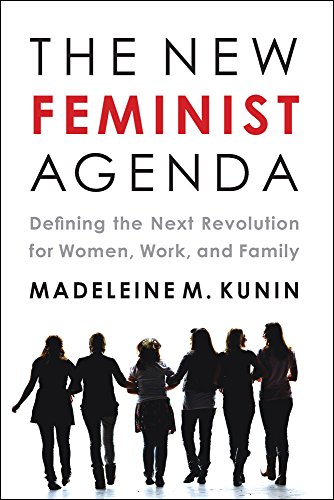
The new feminist agenda : defining the next revolution for women, work, and family / Madeleine M. Kunin.
Material type: TextLanguage: English Publication details: White River Junction, Vt. : Chelsea Green Pub., c2012. Description: 288 p. ; 23 cmISBN: 9781603584258 (hardcover); 9781603582919 (pbk.); 9781603583688 (ebook)Subject(s): Work and family -- United States | Working women -- United States | Feminism -- United StatesDDC classification: 306.36 KUN LOC classification: HD4904.25 | .K865 2012Online resources: OCLC
 | Item type | Current library | Collection | Call number | Copy number | Status | Date due | Barcode | Item holds |
|---|---|---|---|---|---|---|---|---|
 Text
Text
|
Dr. S. R. Lasker Library, EWU Reserve Section | Non-fiction | 306.36 KUN 2012 (Browse shelf(Opens below)) | C-1 | Not For Loan | 25229 | ||
|
Text
|
Dr. S. R. Lasker Library, EWU Reserve Section | Non-fiction | 306.36 KUN 2012 (Browse shelf(Opens below)) | C-2 | Not For Loan | 25230 | ||
|
Text
|
Dr. S. R. Lasker Library, EWU Circulation Section | Non-fiction | 306.36 KUN 2012 (Browse shelf(Opens below)) | C-3 | Available | 25231 |
Abstract:
Feminists opened up thousands of doors in the 1960s and 1970s, but decades later, are U.S. women where they thought they would be? The answer, it turns out, is a resounding no. Surely there have been gains. Women now comprise nearly 60 percent of college undergraduates and half of all medical and law students. They have entered the workforce in record numbers, making the two wage earner family the norm. But combining a career and family turned out to be more complicated than expected. While women changed, social structures surrounding work and family remained static. Affordable and high quality child care, paid family leave, and equal pay for equal work remain elusive for the vast majority of working women. In fact, the nation has fallen far behind other parts of the world on the gender equity front. We lag behind more than seventy countries when it comes to the percentage of women holding elected federal offices. Only 17 percent of corporate boards include women members. And just 5 percent of Fortune 500 companies are led by women. It is time, says the author, to change all that. Looking back over five decades of advocacy, she analyzes where progress stalled, looks at the successes of other countries, and charts the course for the next feminist revolution, one that mobilizes women, and men, to call for the kind of government and workplace policies that can improve the lives of women and strengthen their families.
Includes bibliographical references and index.
Time for a new revolution -- Back to the family, after all -- What can we learn from the rest of the world? -- What can we learn from similar nations: England, Australia, and Canada? -- American exceptionalism, political divisions, and the states -- Win/win: workplace flexibility -- The early years: child care and early education -- New family portraits -- How women leaders make a difference -- What women need to create equal opportunities in the workplace -- Building a coalition -- Child poverty -- How do we win?
Feminists opened up thousands of doors in the 1960s and 1970s, but decades later, are U.S. women where they thought they would be? The answer, it turns out, is a resounding no. Surely there have been gains. Women now comprise nearly 60 percent of college undergraduates and half of all medical and law students. They have entered the workforce in record numbers, making the two wage earner family the norm. But combining a career and family turned out to be more complicated than expected. While women changed, social structures surrounding work and family remained static. Affordable and high quality child care, paid family leave, and equal pay for equal work remain elusive for the vast majority of working women. In fact, the nation has fallen far behind other parts of the world on the gender equity front. We lag behind more than seventy countries when it comes to the percentage of women holding elected federal offices. Only 17 percent of corporate boards include women members. And just 5 percent of Fortune 500 companies are led by women. It is time, says the author, to change all that. Looking back over five decades of advocacy, she analyzes where progress stalled, looks at the successes of other countries, and charts the course for the next feminist revolution, one that mobilizes women, and men, to call for the kind of government and workplace policies that can improve the lives of women and strengthen their families.
Social Science Social Science
Tahur Ahmed
There are no comments on this title.