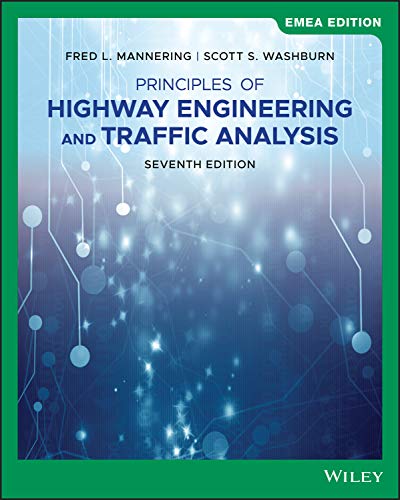
Principles of highway engineering and traffic analysis / Fred L. Mannering and Scott S. Washburn
Material type: TextLanguage: English Publication details: Hoboken, NJ : John Wiley, 2020. Edition: 7th editionDescription: 416 pages : illustrations ; 25 cmISBN: 9781119587316; 9781119493969; 9781119494102Subject(s): Highway engineering | Traffic engineeringDDC classification: 625.7 Online resources: WorldCat details Summary: "In many industrialized nations today, highways present engineers and governments with formidable challenges relating to safety, sustainability, environmental impacts, congestion mitigation, and deteriorating infrastructure. As a result, highways are often viewed from the perspective of the many challenges they present as opposed to the benefits they provide. Historically, highways have always played a key role in the development and sustainability of human civilization. Today, in the United States and throughout the world, highways continue to dominate the transportation system, by providing critical access for the acquisition of natural resources, industrial production, retail marketing, and population mobility. The influence of highway transportation on the economic, social, and political fabric of nations is far-reaching and, as a consequence, highways have been studied for decades as a cultural, political, and economic phenomenon. While industrial needs and economic forces have clearly played an important part in shaping highway networks, societies' fundamental desire for access to activities and affordable land has generated significant highway demand, which has helped define and shape highway networks. Without doubt, highways have had a dramatic impact on the environment in terms of the consumption of nonrenewable resources, air pollution, and the generation of greenhouse gases. In addition, vehicle crashes result in well over a million deaths worldwide every year and are the leading cause of death among people 15 to 29 years old [World Health Organization 2015]. As with other critical infrastructures (such as electrical power generation and distributions systems, water distribution systems, and storm-water and sewage systems), highway systems are costly to build, manage, and maintain, and inadequate management and maintenance can result in additional costs with regard to congestion, safety, and a variety of adverse economic impacts"--
| Item type | Current library | Collection | Call number | Copy number | Status | Date due | Barcode | Item holds |
|---|---|---|---|---|---|---|---|---|
 Text
Text
|
Dr. S. R. Lasker Library, EWU Reserve Section | Non-fiction | 625.7 MAP 2020 (Browse shelf(Opens below)) | C-1 | Not For Loan | 30869 | ||
|
Text
|
Dr. S. R. Lasker Library, EWU Circulation Section | Non-fiction | 625.7 MAP 2020 (Browse shelf(Opens below)) | C-2 | Available | 30870 | ||
|
Text
|
Dr. S. R. Lasker Library, EWU Circulation Section | Non-fiction | 625.7 MAP 2020 (Browse shelf(Opens below)) | C-3 | Available | 30871 | ||
|
Text
|
Dr. S. R. Lasker Library, EWU Circulation Section | Non-fiction | 625.7 MAP 2020 (Browse shelf(Opens below)) | C-4 | Available | 30872 | ||
|
Text
|
Dr. S. R. Lasker Library, EWU Circulation Section | Non-fiction | 625.7 MAP 2020 (Browse shelf(Opens below)) | C-5 | Checked out | 19/09/2023 | 30873 |
Browsing Dr. S. R. Lasker Library, EWU shelves, Shelving location: Circulation Section Close shelf browser (Hides shelf browser)

|

|
|
|
|

|

|
||
| 625.7 GAT 2020 Traffic and highway engineering / | 625.7 MAP 2020 Principles of highway engineering and traffic analysis / | 625.7 MAP 2020 Principles of highway engineering and traffic analysis / | 625.7 MAP 2020 Principles of highway engineering and traffic analysis / | 625.7 MAP 2020 Principles of highway engineering and traffic analysis / | 627.23 CHO 1959 Open-channel hydraulics / | 628 GRE 2014 The green computing book : tackling energy efficiency at large scale / |
Includes index.
"In many industrialized nations today, highways present engineers and governments with formidable challenges relating to safety, sustainability, environmental impacts, congestion mitigation, and deteriorating infrastructure. As a result, highways are often viewed from the perspective of the many challenges they present as opposed to the benefits they provide. Historically, highways have always played a key role in the development and sustainability of human civilization. Today, in the United States and throughout the world, highways continue to dominate the transportation system, by providing critical access for the acquisition of natural resources, industrial production, retail marketing, and population mobility. The influence of highway transportation on the economic, social, and political fabric of nations is far-reaching and, as a consequence, highways have been studied for decades as a cultural, political, and economic phenomenon. While industrial needs and economic forces have clearly played an important part in shaping highway networks, societies' fundamental desire for access to activities and affordable land has generated significant highway demand, which has helped define and shape highway networks. Without doubt, highways have had a dramatic impact on the environment in terms of the consumption of nonrenewable resources, air pollution, and the generation of greenhouse gases. In addition, vehicle crashes result in well over a million deaths worldwide every year and are the leading cause of death among people 15 to 29 years old [World Health Organization 2015]. As with other critical infrastructures (such as electrical power generation and distributions systems, water distribution systems, and storm-water and sewage systems), highway systems are costly to build, manage, and maintain, and inadequate management and maintenance can result in additional costs with regard to congestion, safety, and a variety of adverse economic impacts"--
Civil Engineering Civil Engineering
There are no comments on this title.