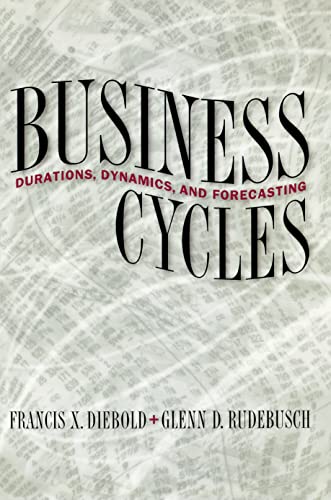
Business cycles : durations, dynamics, and forecasting / Francis X. Diebold and Glenn D. Rudebusch.
Material type: TextLanguage: English Publication details: Princeton, N.J. : Princeton University Press, c1999. Description: xiii, 420 p. : ill. ; 25 cmISBN: 0691012180 (alk. paper); 9780691012186Subject(s): Business cycles -- Statistical methods | Business forecasting -- Statistical methodsDDC classification: 338.5420151 LOC classification: HB3711 | .D54 1999Online resources: WorldCat details
 | Item type | Current library | Collection | Call number | Copy number | Status | Date due | Barcode | Item holds |
|---|---|---|---|---|---|---|---|---|
 Text
Text
|
Dr. S. R. Lasker Library, EWU Reserve Section | Non-fiction | 338.5420151 DIB 1999 (Browse shelf(Opens below)) | C-1 | Not For Loan | 26960 |
Browsing Dr. S. R. Lasker Library, EWU shelves, Shelving location: Reserve Section Close shelf browser (Hides shelf browser)

|

|

|

|

|

|

|
||
| 338.542 DOI Doing business 2007 : | 338.542 LIT The teamNet factor : | 338.542 SOM 1988 Monetary and fiscal policy and business cycles in the modern era / | 338.5420151 DIB 1999 Business cycles : | 338.542015118 AGV2005 Volatility and growth / | 338.544 PIE 1976 Econometric models and economic forecasts / | 338.5442 MAF 2013 Forecasting : |
Includes bibliographical references and indexes.
TOC PrefaceAcknowledgmentsPt. IIntroduction1Questions about Business Cycles5Pt. IIBusiness Cycle Durations2Have Postwar Economic Fluctuations Been Stabilized?353Shorter Recessions and Longer Expansions544A Nonparametric Investigation of Duration Dependence in the American Business Cycle645Further Evidence on Business Cycle Duration Dependence876Measuring Business Cycles: A Modern Perspective1177Regime Switching with Time-Varying Transition Probabilities144Pt. IIIBusiness Cycle Dynamics8Trends and Random Walks in Macroeconomic Time Series: A Reexamination1699The Uncertain Unit Root in Real GNP19410The Uncertain Unit Root in Real GNP: Comment20711Long Memory and Persistence in Aggregate Output21912Is Consumption Too Smooth? Long Memory and the Deaton Paradox24113On the Power of Dickey-Fuller Tests against Fractional Alternatives258Pt. IVBusiness Cycle Forecasting14The Past, Present, and Future of Macroeconomic Forecasting26715Scoring the Leading Indicators29016Turning Point Prediction with the Composite Leading Index: An Ex Ante Analysis31617Forecasting Output with the Composite Leading Index: A Real-Time Analysis34218New and Old Models of Business Investment: A Comparison of Forecasting Performance36119Comparing Predictive Accuracy387Name Index413Subject Index419
Summary:
Offers an econometric analysis of business cycles. This book addresses five principal questions about the measurement, modeling, and forecasting of business cycles. It asks whether business cycles have become more moderate in the postwar period, concluding that recessions have, in fact, been shorter and shallower.
Economics
Tahur Ahmed
There are no comments on this title.